Shannyn Barker
Cline
ENG 102
1 November, 2011
Vampires: Myths or Human?
The Vampire has been an icon in literature and film for almost two hundred years. Vampires today are shown in a totally different way than they were when the myths were told, and Bram Stoker’s Dracula was written. Today’s vampires are portrayed more vogue, glamorous, almost human in a since, whereas the mythical creatures, and Dracula were literally monsters. It seems that vampires, who were once hideous, fearsome creatures, are becoming more and more human. How and why has this dramatic change occurred to something that people used as a horror story?
In order to answer this question, we have to start with the vampire as a mythical creature. The Oxford Dictionary defines mythical as “something existing only in ancient myths.” Basically, the vampire is something we’ve heard about in relation to ancient myths as part of the mythology of that culture. Laurence Coup (2009) states that “the word ‘myth’ is used rather loosely as a synonym for ‘ideology’ or ‘fantasy’, but that although they do overlap at times, that they should not be used interchangeably.” From the Greek mythology there is Lamia, who was a Libyan queen. It’s said that she caught the interest of Zeus, and all of her children were fathered by him. When Hera found out, she was in a fit of jealousy, and took all of her children away. Lamia went to live in a cave, and since she couldn’t take out her furry on Hera, she killed the babies of random human mothers by sucking their blood (Melton 1999). Thus, making the vampire a myth was using it as an explanation of inexplicable problems or evils.
The first written evidence to be found on vampires was, according to Bartlett and Indriceanu (2005), was located on a seal of a cylinder in Babylon in the third millennium BC (Bartlett and Idriceanu 2005: 4). This was a female demon called a labartu which fed on humans, animals, but mainly liked children (2005). Ever since humans started recording history, there have been vampires or vampire-like creatures, such as the labartu, written throughout mythology and appearing in almost every culture throughout the world. J. Gordon Melton’s The Vampire Book – The Encyclopedia of the Undead (1999) lists no less than twenty-four different countries and cultures, from ancient Babylon and Assyria to today that refer to vampires and vampire-like creatures. They are not all portrayed the same in each culture, but they do have some of the same characteristics such as drinking blood and only coming out at night. “A vampire is usually the result of a transformation where the innocent become corrupted” (Bartlett and Idriceanu 2005:3). Vampirism requires certain identifying characteristics as a mythical figure and rules that govern their existence (Melton 1999, Bartlett and Idriceanu 2005, Suckling 2006). The rules and characteristics listed are the most common ones, and not all mythical vampires have to embody all of them, but at least have an association with some of them in order to be categorized as a ‘vampire’. The most basic feature of the vampire is the fact that they bite people or animals to drink their blood in order to survive. Second is their pale skin and being cold to the touch and red eyes. It’s also said in some myths that they had hair growing on the back of their hands. In the earlier literature, such as Dracula, vampires slept in coffins, but in the vampires of today they do not.
Vampire literature is not a genre in itself, but belongs to many different ones. Vampires belong to the gothic/romance fiction, sci-fi/fantasy, crime, chick-lit, children’s or youth literature and many more. Wayne Bartlett and Flavia Idriceanu (2005) states “that the vampire myth grows in scope with every contribution to vampire literature that is written.” Basically, with each character based story that is written, there are certain rules and characteristics that the writer likes to fallow therefore adding a new contribution to the vampire. Of course you have the stereotypical rules and characteristics such as fangs, they suck blood to survive, only come out at night, allergic to sunlight, can’t eat garlic, crucifixes will keep them away from you, and they can only enter your home if they are invited in. The author of the text gets to choose what characteristics they give to their vampires, what rules they have to fallow, and so forth. This is one of the reasons that the vampire is such a popular figure in literature and movies today.
Bram Stoker’s Dracula (1897) was chosen to help support this because one it’s a literary classic, but also because for a long time it defined the manner in which the vampire was to be portrayed in literature and film. Dracula was written at the end of the Victorian age in England where Gothic Fiction was still very popular. Alexandra Warwick says in her essay ‘Victorian Gothic’(2007), is that “In the popular imagination the Victorian is in many ways the Gothic period, with its elaborate cult of death and mourning, its fascination with ghosts, spiritualism and the occult, and not least because of the powerful fictional figures of the late century” (29). The people in this period wanted stories about haunted castles, heroes, villains, and the supernatural phenomenon such as vampires. Dracula was your typical vampire; he drank blood, hated sunlight, was pale, only came out at night, slept in a coffin and in the end was finally killed by humans with a stake in the heart and turned to dust. “There lay the Count, but looking as if his youth had been half-renewed, for the white hair and moustache were changed to dark iron-grey; the cheeks were fuller, and the white skin seemed ruby red underneath; the mouth was redder than ever, for on the lips were gouts of fresh blood, which trickled from the corners of the mouth and ran over the chin and neck” (Stoker 1998: 51). Jonathan says this after finding Dracula sleeping in his coffin. This implies to the reader that Dracula has recently fed, so therefore his appearance has changed. Dracula also shows that he has supernatural powers. First, when he discovers that Jonathan is seduced by the three vampire woman he grabs ahold of one of the women with “a giant’s power” (Stoker 1998, 38). Then again Van Helsing says “the Count is as strong as twenty men” (Stoker 1998, 237). Dracula never wanted to live with humans, interact with them, he never felt sorry for his actions, or wanted to have a “normal” life. He was a monster who used humans to better himself and his needs.
Even though Dracula inspired so many films too made after being published, it was time for a new way to see vampires than as the evil and menacing figure that Dracula laid down. This change was not only from evil and menacing to kinder and more sympathetic, but the vampires started to question their predatory nature. A prime example of this is the vampire Louis de Pointe du Lac in Anne Rice’s Interview with the Vampire (1976). Anne Rice’s book was considered to be the most important contribution to vampire literature in the 20th century. It’s an innovative portrayal of this new and more modern vampire. Interview with the Vampire was published in 1976 and tells the story of three main vampires, Louis, Lestat, and Claudia in 18th century New Orleans. Louis became so grief stricken after the death of his brother, that he started frequenting taverns and other places of ill repute, he got into fights and duels with anyone he could hoping that they would kill him to end his misery, but none of that worked and he lived. One night he is attacked and fed upon by the vampire Lestat, thus turning Louis into a vampire. Afterwards, once Louis has figured out what he is, he is filled with remorse anguish over the ethical implications of being a vampire. Louis and Lestat transform a little girl, Claudia, and she and Louis create a special bond. After tragically loosing Claudia, Louis flees to the United States where he decides to do the interview with a reporter. Anne Rice transformed the mythical creature to fit into the society of contemporary culture. The vampire in this novel is now able to say something about the 1970’s just as Dracula was able to say something about the Victorian Age. All of these characters are dynamic characters, even if they do not change throughout the novel, they want to change which is more than the characters in Dracula.
The vampires in Rice’s novel have little of the same characteristics as Dracula does. They too have rules that apply to their existence, for instance they can move at the speed of light (Rice 1998: 27), their senses are heightened (23), they will burn to death and also sleep in a coffin during the day (26). Electric light is harmless to them (8), same with crucifixes and stakes through the heart as we see in this dialog between Louis and the reporter.
'Oh, the rumor about crosses!' the vampire laughed. 'You refer to our being afraid of crosses?'
'Unable to look on them, I thought,' said the boy.
'Nonsense, my friend, sheer nonsense. I can look on anything I like. And I rather like looking on crucifixes in particular.'
'The story about stakes through the heart,' said the boy, his cheeks coloring slightly.
'The same,' said the vampire. 'Bull-shit,' he said carefully articulating both syllables, so that the boy smiled. 'No magical power whatsoever….' (25).
Not only are Rice’s vampires not bothered by the things listed above, they also cannot drink blood from a dead body. (Rice 1998: 31). This is how Claudia is able to “kill” Lestat. She drugged two boys with absinthe and laudanum, laudanum keeps the blood in a dead body warm for a while. Lestat, who in good faith believes that the boys are still alive, drinks their blood and immediately starts convulsing and gasping for air (124). Rice not only reinvents the vampire as a mythical icon, but also devised new rules that apply specifically to hers. Yes, they are not evil, bloodsucking creatures, but have feelings and are self-reflective; yet they still induce fear and awe in readers and the human characters in the novel.
Vampire literature and films before 1980 was mainly directed at adults, but later the literature and films are more directed to include teens, and children. Some examples of this literature are Fifth Grade Monsters (1987-91) by Mel Gilden, The Vampire Diaries (1991-92 and 2009 TV series) by L.J. Smith, and the Twilight series (2005-08) by Stephanie Meyer. Not only is there a shift in the target of vampire audiences, there’s a new way to portray them, one that differs from Dracula and Interview with the Vampire. Even though Anne Rice started the vampire characteristics coming closer to humans, those listed above get even closer. In Interview with the Vampire they are closer to looking like humans than in Dracula, but in the newer novels the vampires are even more human-like in looks and desires.
The Twilight series (2005-2008) is written for a younger audience, consisting of four books; Twilight (2005), New Moon (2006), Eclipse (2007), and Breaking Dawn (2008). They tell the story of Bella Swan, a seventeen year old girl who moves in with her dad and falls in love with a vampire, Edward Cullen. This is a story of a forbidden love between a vampire and a human. Not only are there Bella and Edward, but Edwards’s vampire family and other vampires. The Cullen’s consist of his parents Esme and Carlisle, his brothers Jasper and Emmet, and his two sisters Rosalie and Alice. The Cullen’s, along with other vampires listed in the book, are portrayed according to a new interpretation of the vampire myth, but there are still sinister vampires like the ones found in Dracula and Interview with the Vampire. These aspects show the reader that the present day vampire is no longer just one thing, but are just as diverse as humans are. One of these characteristics that stay the same from Dracula, Interview with the Vampire, to the Twilight series is that vampires have a very keen sense of smell. Their sense of smell, sight and hearing are very enhanced, and they also have supernatural speed and strength (Meyer 2005: 20, 228). The first look at these characteristics is in the first book Twilight when Bella is almost crushed by a van in the school parking lot. Bella is narrating:
Two long, white hands shot out protectively in front of me, and the van shuddered to a stop a foot from my face, the large hands fitting providentially into a deep dent in the side of the van's body. Then his hands moved so fast they blurred (48).
This shows us that Edward isn’t like any “normal” teen that goes to her high school. Another trait that the vampires of Twilight have that is similar to the other books above is that they do not eat or sleep (119), and they do not have to stay in coffins during the day. In this passage, Bella questions Edward similar to the reporter questioning Louis in Interview with the Vampire.
“Don't laugh – but how can you come out during the daytime?”
He laughed anyway. “Myth.”
“Burned by the sun?”
“Myth.”
“Sleeping in coffins?”
“Myth.” He hesitated for a moment, and a peculiar tone entered his voice. “I can't sleep.”
It took me a minute to absorb that. “At all?”
“Never,” he said (161-162).
There are many characteristics that are the same in Twilight as in the other books from before, but Meyer chose to leave out the repugnance to holy objects and the sunlight because, well let’s face it, they are outdated. She kept these, got rid of some, and added a few new ones. Such as vampires are hard like marble and are glittery in the sun. These are new characteristics for her vampires, which are different from the past and may change the future vampire.
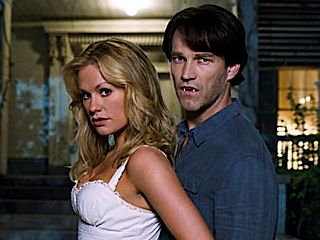
Charlaine Harris’s Southern Vampire Mysteries (Sookie Stackhouse novels, 2001-), are similar to the Twilight vampires. The series contains eleven books as of today, all about Sookie Stackhouse, a young waitress in Bon Temps, Louisiana who is telepathic. She has many adventures dealing with the supernatural on a day to day basis. These books are in the form of crime mystery that revolves around vampires and supernatural beings. The main difference from this series to any other vampire novel out there is that vampires are public knowledge instead of just one person knowing about them. Vampires decided that it was safe to let the world know about them after the Japanese developed synthetic bottled blood for the vampires to live of off instead of draining humans (Harris 2003: 4). Another change that Harris took hold of is that there is vampire royalty, sort of like Twilight’s royalty. The United States is divided up into kingdoms, with a king or queen to rule it. Then, their kingdom is divided into Areas, where there is a sheriff to lead it and report back to the king/queen. These are the vampire authorities who enforce vampire laws and regulations (37-38).
In Harris’s series, the vampires are beautiful, intriguing, and dangerous. Compared to the Twilight series, there are a lot more “bad” vampires than “good”, because the audiences are different. Sookie, like Bella, is intrigued the first time she meets Bill. She narrates this next passage to show us:
He was a little under six feet, I estimated. He had thick brown hair, combed straight back and brushing his collar, and his long sideburns seemed curiously old-fashioned. He was pale, of course (…) his lips were lovely, sharply sculpted, and he had arched dark brows. His nose swooped down right out of that arch, like a prince's in a Byzantine mosaic (…) his eyes were even darker than his hair, and the whites were incredibly white (Harris 2001: 2).
Harris fallows the tradition of having vampires that are perfect and are irresistible to look at. The other characteristics of the vampires in The Southern Vampire Mysteries are similar to the other books discussed. They are very strong (Harris 2001: 55), fast (51), they have enhanced senses (176-177), allergic to sunlight (7), and they can be killed with a steak through the heart. Before they came out Bill told Sookie that “we had to persuade people we were harmless…or assure them they hadn't seen us at all…or delude them into thinking they'd seen something else” (57). This was them using their other supernatural power of “glamor”, basically controlling a human’s brain to think differently, to forget something they saw and think it was something else instead. A different characteristic that Harris gave her vampires was the fact that they are allergic to silver (Harris 2002: 195). She also kept some of the “normal” characteristics from the myths such as Bill can levitate (Harris 2001: 57), cannot enter a house unless they are invited in (Harris 2002: 235), and their fangs are normally retracted, but can come out whenever they are aroused or hungry (Harris 2001: 218). Harris has made her vampires a part of the human world; they hold human jobs, live in houses in gated communities, and go out on the town to have a good time. So the reader could clarify who was human and who was a vampire, Harris made sure that her vamps had the characteristics and rules needed, yet still on the human border line.
All in all, there are vampires and then there are vampires. Meaning no vampire, neither in folklore nor literature is one in the same. The vampire has definitely become more human over the centuries and with each other writer that writes about them. The vampire, as a mythical creature, started out fundamentally different to humans, and the contemporary vampire has become closer and closer to being human.
Work Cited
Bartlett, Wayne and Flavia Idriceanu. 2005. Legends of Blood. The Vampire in History and
Myth. Stroud: Sutton Publishing Ltd.
Coupe, Laurence. 2009. Myth. 2nd edition. New York: Routledge
Harris, Charlaine. 2001. Dead Until Dark. London: Orion Books
Harris, Charlaine. 2002. Living Dead in Dallas. London: Orion Books
Harris, Charlaine. 2003. Club Dead. London: Orion Books
Melton, J. Gordon. 1999. The Vampire Book. The Encyclopedia of the Undead. Detroit: Visible
Ink Press
Meyer, Stephenie. 2005. Twilight. London: Atom Books
Meyer, Stephenie. 2006 New Moon. London: Atom Books
Meyer, Stephenie. 2007. Eclipse. London: Atom Books
Meyer, Stephenie. 2008. Breaking Dawn. London: Atom Books
“Mythical adj.”The Oxford English Dictionary.3rd ed. 2011. OED Online.
Rice, Anne. 1976. Interview with a Vampire. London: Sphere
Stoker, Bram. 1998. Dracula. Oxford: Oxford University Press
Suckling, Nigel. 2006. Vampires. London: AAPPL
Warwick, Alexandra. 2007. 'Victorian Gothic.' In Catherine Spooner and Emma McEvoy (eds.),
The Routledge Companion to Gothic. London: Routledge. 29-3